Android Emergency Location Service (ELS) was my first product as a PM at Google. When someone calls or texts an emergency number from an Android device, ELS automatically determines their precise location and delivers it directly to emergency services — no action required from the caller.
The problem it solves is fundamental: when someone is in crisis, they often can't describe where they are. Cell tower triangulation — the traditional fallback — was wildly imprecise, sometimes placing a caller within a 3km radius. Seconds matter. Accuracy matters.
How It Works
When an emergency call is placed, ELS triggers the Android Fused Location Provider, which combines GPS, Wi-Fi, cell, and sensor data to establish the most accurate position possible as quickly as possible. That location is sent directly and securely to emergency services — bypassing Google entirely. If location settings are off on the device, ELS has privileged access to enable them for the duration of the emergency.
ELS works on all Android devices running Gingerbread (2.3.7) or later, which meant near-universal Android coverage from day one. It is on by default, requires no app install, and works in the background without interrupting the call.
Scale & Impact
140K+
emergency calls assisted per day
14
countries at launch
76%
reduction in location uncertainty radius (US testing: 159m → 37m)
In the UK, early testing found that existing cell-based location could only place a caller within a 3km radius. With ELS, more than half of those same calls were accurate to within 20 meters.
According to the FCC, improving emergency location accuracy by just one minute saves over 10,000 lives annually in the US alone.
Deployment
ELS launched first in the UK and Europe, then expanded to Australia, New Zealand, the UAE, and Saudi Arabia before rolling out to the United States in partnership with RapidSOS and T-Mobile. The US rollout required working closely with carriers and emergency communication centers to integrate location data into existing 911 infrastructure — a challenge as much about policy and partnerships as it was about technology.
ELS is now deployed across the US, UK, most of Europe, Australia, New Zealand, UAE, and Saudi Arabia.
Overview
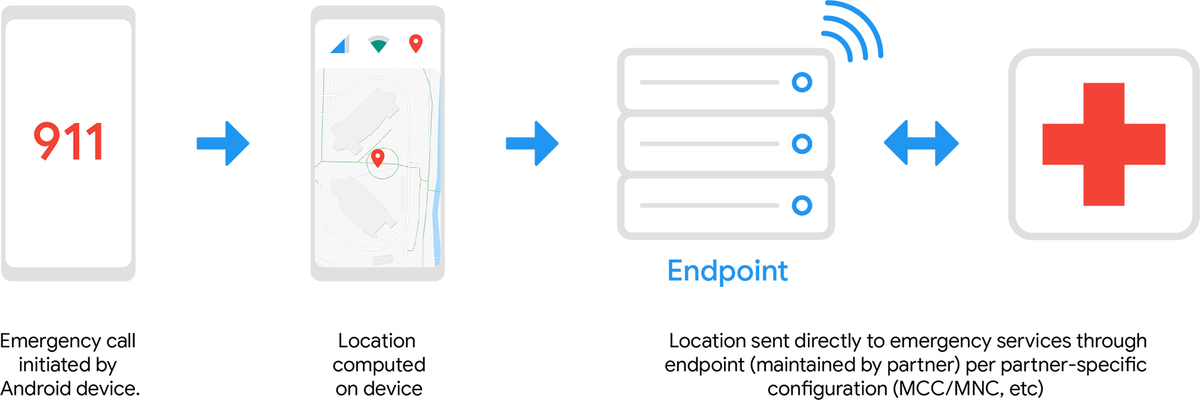 ELS works on all Android devices running Gingerbread (2.3.7) or later, which meant near-universal Android coverage from day one. It is on by default, requires no app install, and works in the background without interrupting the call.
Scale & Impact
ELS works on all Android devices running Gingerbread (2.3.7) or later, which meant near-universal Android coverage from day one. It is on by default, requires no app install, and works in the background without interrupting the call.
Scale & Impact